PHPOG CMS 4.00 Is Complete: 23 Years of Learning, Coding and Refinement
After years of coding, testing, rebuilding and refinement, PHPOG CMS 4.00 is complete; the public release will follow after at least 45 more days of private testing, theme development and module perfection.
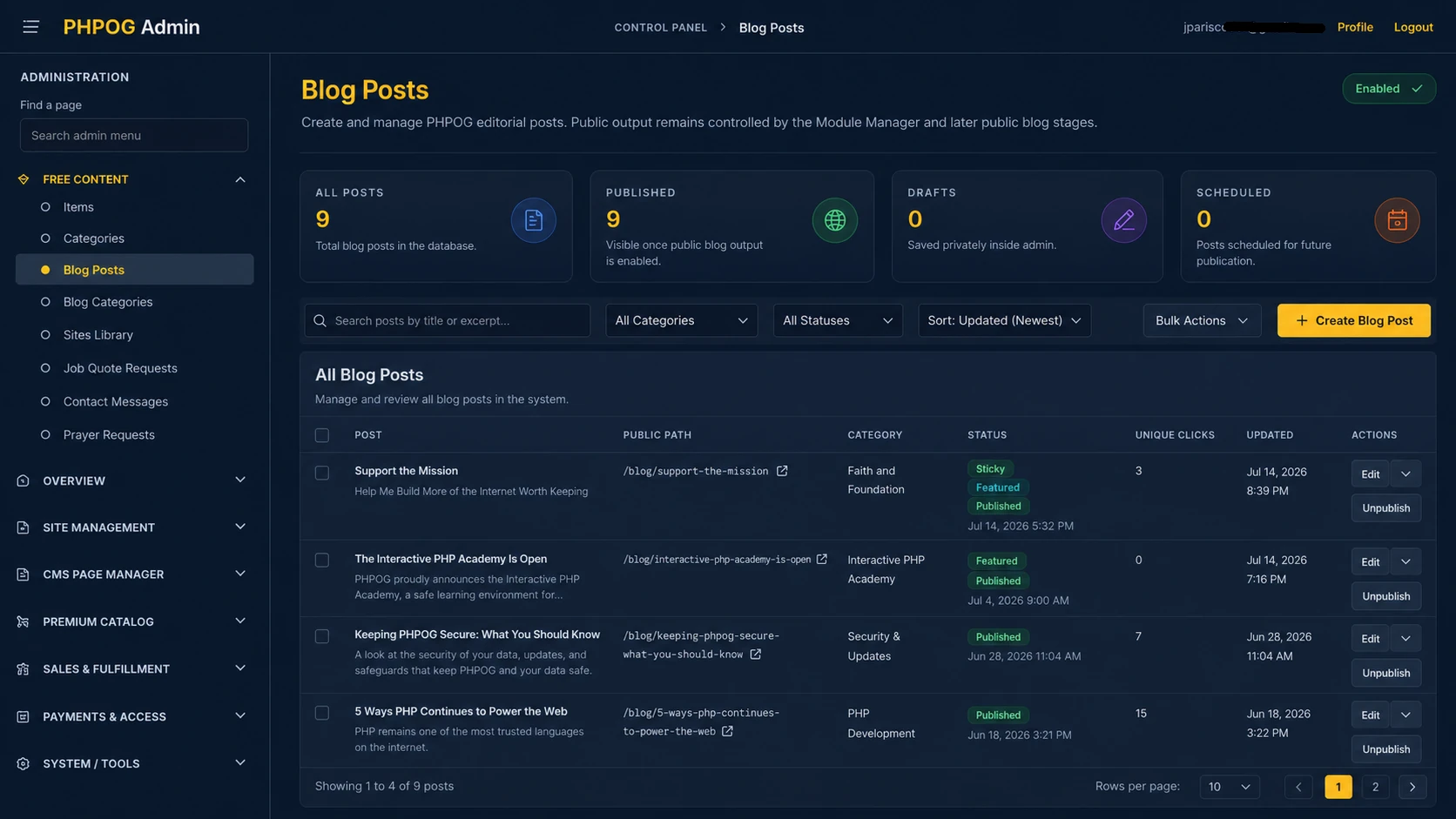
I’ve spent years coding, testing, rebuilding and refining PHPOG CMS; the original vision, however, began about 23 years ago. At the time, I believed I could already see where many content management systems were heading. They were becoming larger, heavier and increasingly dependent on themes, plugins and third-party systems that didn’t always share the same standards or long-term goals.
I believed there had to be another way to build websites; not by rejecting everything that already existed or assuming my approach was the only right one, but by learning from what worked, watching what failed and keeping control close to the people responsible for the system.
Turning that early vision into something dependable took much more than writing a few files and placing an administration panel around them. Some systems had to be rewritten more than once; some of my assumptions didn’t survive real testing and some ideas that looked good on paper simply didn’t belong in the final architecture.
There were times when progress meant moving quickly; there were also times when progress meant stopping, admitting something wasn’t good enough and rebuilding it more carefully. That’s part of software development and, in many ways, part of life. You learn, you fall, you adapt and you keep moving until the work begins to reflect what the road taught you.
PHPOG CMS 4.00 Is Now Complete
I’m proud of reaching that milestone, but it’s a quiet and grounded kind of pride. It doesn’t come from believing every decision was right the first time, claiming that my approach is right for everyone or pretending the road was easy; it comes from knowing I stayed with the work, learned from the failures and continued refining the system until it became something I could honestly stand behind.
A live installation is already running inside a private proving area, where I’ll continue testing the complete system under real conditions. During that time I’ll be refining themes, widgets and modules; watching performance, testing different configurations and making sure the pieces work together as one complete platform rather than merely appearing complete because the individual features are present.
The initial public release is being prepared primarily for independent developers, experienced hobbyists, agencies and technically involved website owners who want a capable system without surrendering control of the underlying application. It may also serve people building client websites, publishing platforms, membership systems, stores or specialized projects who value understandable code, defined boundaries and the ability to choose which features their installation carries.
I won’t be offering PHPOG CMS publicly for at least 45 days. The core system is complete, but I don’t want the first public version to arrive as an empty shell and ask people to imagine what it may eventually become. I need to release it with the content, themes, modules and widgets required to properly demonstrate the vision behind it and give people a fair opportunity to understand what I’ve tried to build.
This new system isn’t about delaying the work to create anticipation, but rather about giving the first release the time & care required to make it work, look and feel how I envisioned it 23 years ago. There’s no such thing as perfect, and I know there’ll always be more to learn and improve, but this will hopefully bring the system closer to that impossible goal.
The additional private-testing period gives me room to catch the small things that are easy to miss while building the larger foundation. It also gives me the opportunity to test the CMS across different kinds of websites, themes and module combinations before asking anyone else to trust it with their own work.
PHPOG CMS isn’t a renamed copy of another content management system; it also isn’t an existing framework with a new administration panel placed over it. It was written from the ground up for the traditional LAMP stack.
What PHPOG CMS Doesn’t Require
- A PHP framework merely to operate
- A frontend framework merely to operate
- jQuery
- A visual page builder
- A large collection of outside libraries
What PHPOG CMS Uses
- PHP 8
- MySQL or MariaDB
- Apache
- HTML
- CSS
- Vanilla JavaScript
That isn’t meant to suggest frameworks, libraries or page builders have no value or that every developer should make the same choices. They solve real problems for many projects and teams. It means PHPOG uses the modern capabilities already available inside PHP, browsers and servers without automatically placing additional layers between the website and the technology running it when I don’t believe those layers are necessary.
Apache will remain the primary supported web server for the initial release; however, I’ll also be working on NGINX support for developers and server administrators who prefer server blocks over an .htaccess file. That support will follow the same PHPOG approach: clear routing contracts, documented configuration and predictable behavior rather than leaving users to piece together incomplete rewrite examples on their own.
I wanted to create a CMS capable of serious work while still remaining understandable. A platform can offer hundreds of capabilities without forcing every installation to load every one of them; a website should be able to grow without becoming trapped inside a tangled collection of extensions that overwrite one another, compete for control and leave the owner nervous every time an update becomes available.
That goal shaped nearly every major decision inside PHPOG CMS, even when following it required more time, more testing or reconsidering decisions I’d already made.
Built From Real Experience
I’ve worked with websites long enough to see how quickly a simple project can become difficult to manage. A theme may gradually begin performing work that belongs in the application; a plugin may reach directly into another plugin’s tables, a payment provider may become tangled into account management and a widget may begin changing information when it was only supposed to display it.
These choices are rarely made because someone wants to create a difficult system. Each shortcut may seem harmless when it’s first added and, for a while, it may genuinely save time or solve an immediate problem. Over the years, though, those shortcuts can pile up; the boundaries disappear and eventually nobody knows which part owns the information, which update caused the problem or whether repairing one feature will quietly damage another.
PHPOG CMS was designed in an effort to reduce that kind of confusion. The core owns the responsibilities every installation needs; optional business features remain inside isolated modules, themes control the design without controlling security and widgets display focused information without receiving unrestricted authority over the application.
A blog doesn’t need to load marketplace code; a company website doesn’t need subscription tables and a membership website doesn’t need physical inventory management unless those systems are actually installed and serving a purpose.
The platform can be broad without requiring every individual website to carry the weight of features it doesn’t use.
A Complete Content Management Foundation
The PHPOG CMS core provides a complete foundation for creating and managing public content. Administrators can build pages using structured rows, columns and content blocks; they aren’t required to hand the entire website over to a large visual page builder simply to create an organized layout, though those tools may still be the right choice for other systems and users.
Pages can be drafted, revised, previewed, scheduled and published through one consistent workflow. The preview system uses the real public renderer, which means the administrator reviews the page as it’ll actually appear rather than relying on an approximation produced inside the administration area with different templates or behavior.
Reusable content blocks make it possible to manage shared information from one location and place it throughout the website. These may include announcements, legal notices, calls to action, contact information, donation messages or any other content that needs to remain consistent across several pages.
The media system tracks uploads, references and ownership instead of placing files into a directory and losing sight of how they’re being used. When an image or document is removed from a page, the system checks whether it’s still being used elsewhere or protected by an existing revision; only then can it become eligible for cleanup.
Drafts, autosaves, revisions, temporary files, generated assets, quarantine items, cached files and deleted content all follow defined lifecycle rules. The goal is for the system to understand why a file exists, which package owns it and when it may be safely removed rather than making assumptions that could place someone’s work at risk.
SEO and Clean URLs Built Into the System
Search-engine optimization shouldn’t always require installing another large plugin and hoping it understands every part of the website. PHPOG CMS includes centralized support for search-engine-friendly URLs, canonical addresses, redirects, page titles, meta descriptions, Open Graph data, indexing controls and sitemap integration.
Routes are managed through a central registry; modules can add clean public URLs without writing uncontrolled Apache rules or taking ownership of the main .htaccess file.
The Apache configuration can be generated from validated system contracts, tested before activation and protected by known-good recovery copies. A failed route update shouldn’t leave the entire website inaccessible behind a broken configuration file; the system should understand what changed and provide a dependable path back to the last accepted state.
Slug generation uses centralized validation and administrator-reviewable stop-word rules. Titles, descriptions, slugs and other important content fields follow shared contracts so every page and module doesn’t have to invent a slightly different version of the same behavior.
Search indexes, sitemaps, redirects and caches receive controlled invalidation when content changes; this is intended to keep them synchronized without permanently tangling those systems together.
Modules With Real Isolation
PHPOG modules are self-contained, versioned packages with declared ownership. Each module includes a stable identity, compatibility requirements, dependencies, permissions, routes, services, database requirements, migrations, assets, widgets, checksums and health checks.
Every module receives its own reserved database-table prefix; it can’t create, alter or directly control tables owned by the core or another module. When information needs to cross a boundary, the modules communicate through documented services rather than reaching directly into one another’s data.
This approach requires more discipline while writing a module, and I understand that it may feel stricter than the patterns some developers prefer. My hope is that the additional structure creates a safer and more understandable system later. An administrator can determine which package owns a feature, which tables belong to it and what can be safely upgraded, disabled or removed.
Packages are inspected and quarantined before they’re trusted. Their paths, manifests, checksums, compatibility, dependencies, migrations, permissions, routes and assets are validated before activation; the system doesn’t assume a package is safe merely because it was uploaded through the administration area.
Activation is atomic. A package shouldn’t get halfway installed and leave abandoned tables, partial migrations or broken routes behind; when activation fails, PHPOG is designed to return to the previously accepted state.
Core updates and module updates also remain separate. Updating the CMS doesn’t silently replace optional modules; updating a module doesn’t grant it permission to overwrite the core.
Hooks That Extend the System Without Taking It Over
A modular CMS needs hooks, events and service contracts so separate systems can work together; however, hooks can become difficult to trace when every action may be intercepted by an unknown number of extensions running in an unknown order.
I didn’t want PHPOG CMS to become that kind of system, especially after seeing how difficult those interactions can be for the people responsible for diagnosing a problem.
PHPOG uses typed registries, versioned services and narrow documented hooks. Registries handle predictable additions such as routes, administrator navigation, public-account panels, permissions, widgets, search sources, sitemap sources, scheduled jobs, cache invalidators and health checks.
Versioned services allow one system to request an approved operation from the system that owns it; Commerce owns commerce operations, Accounts owns identity operations, Payments owns payment operations and Support owns support operations.
Hooks and events are used when several modules may safely respond to the same documented action. Each hook has a stable name, version, expected payload, execution phase, return contract and sensitivity level; enabled registrations are then compiled and cached during activation so an ordinary page request doesn’t repeatedly search the database for listeners.
Hook execution is deterministic and measurable. Slow listeners can be identified, failures can be attributed to the package that caused them and repeatedly failing non-critical listeners can be automatically suspended for administrator review rather than being allowed to continue disrupting the system without explanation.
There are deliberate limits as well. Hooks can’t rewrite raw SQL, bypass authentication, approve refunds, accept unverified payment webhooks, make password decisions or inject unrestricted executable code into a page.
Modules can extend PHPOG CMS, but they aren’t given quiet or unrestricted control over the rest of the system.
Themes Control the Appearance, Not the Application
PHPOG themes can completely change the appearance and layout of a website while remaining presentation packages. They don’t query private database tables, inspect protected sessions or make decisions involving payments, permissions and account access.
The template system uses documented tags with separate inner and outer templates. Outer templates control the overall page structure; inner templates control focused areas such as forms, lists, cards, widgets and module views.
There’s no PHP inside the template files. This keeps the design layer readable and helps prevent a theme from becoming an unreviewed application hidden inside the presentation system.
The Theme Manager handles installation, validation, compatibility, activation and recovery. Themes can declare layouts, menus, footer areas, widget regions and required assets; they still remain inside the same package and security rules used throughout PHPOG CMS.
CSS, JavaScript, fonts and other frontend resources are controlled through a central asset registry. The core, themes, modules and widgets declare the assets they need; PHPOG then loads them in a predictable order.
Appropriate files can be validated, combined and published under content-hashed filenames that browsers can cache safely. A page receives the assets required by its active theme and features rather than automatically loading every stylesheet and script available anywhere in the installation.
Widgets With Defined Boundaries
Widgets make it possible to place menus, forms, search tools, recent content, account information and module-powered displays throughout a theme.
PHPOG widgets follow narrower rules than full modules. A widget can’t create its own business tables, register payment webhooks, run migrations or quietly perform state-changing operations while a public page is rendering.
A widget displaying information owned by a module must request that information through the module’s service contract. A commerce widget asks the Commerce module for approved product information; a subscription widget asks the Subscriptions module for the access state it’s permitted to display.
The widget doesn’t reach directly into private tables; if the required module is missing, disabled or unhealthy, the widget is designed to fail safely without exposing protected information or producing a fatal public error.
Public Accounts Remain Independent
Many systems treat every public account as a customer account, often because commerce was the original reason the account system was created. That can become a problem when a website needs members, students, support users, private readers or community participants who’ve never purchased anything.
Public identity belongs to the PHPOG CMS core. Commerce, subscriptions, support and other modules may use that identity; none of those modules owns the person or defines the full purpose of their account.
Administrator accounts remain separate from public accounts because public identity and system administration carry completely different security responsibilities.
The account system includes registration, email verification, secure password login, passwordless email-code login, password recovery and session management.
Account holders can manage their profile, email address, password, multi-factor authentication, recovery codes, active sessions, recent sign-ins and privacy settings. Installed modules may add approved panels for memberships, purchases, downloads, receipts, support activity and other services; personal-data exports and account-closure requests are handled through bounded, auditable processes rather than unrestricted database downloads.
Subscriptions and Protected Access
The Subscriptions module supports versioned membership packages with defined billing options and positive access grants. Access can be provided to an entire module, category, feature, individual content item, protected download or another stable target declared by the system that owns it.
Versioned packages prevent a later change from silently rewriting what an existing customer purchased; newly added features aren’t automatically granted to older packages without administrator review.
Protected access is checked across public pages, direct routes, search results, sitemaps, feeds, widgets, downloads and cached output. Subscriber-only information shouldn’t appear in a public cache, sitemap or search excerpt simply because one part of the system failed to perform the same permission check.
Customers can review their package, billing interval, renewal information, status, included access, receipts and available actions from their account dashboard.
Commerce, Payments and Protected Downloads
PHPOG CMS supports commerce, subscriptions, digital sales, marketplace transactions, coupons, receipts, protected downloads, payment reconciliation and controlled refund requests.
The Payments module provides one internal contract for payment attempts, captures, recurring agreements, transactions, refunds, normalized events and reconciliation.
Stripe and PayPal operate through separate provider modules; this allows Commerce and Subscriptions to work with either provider without spreading provider-specific code throughout the entire CMS.
Sensitive payment information remains with the payment provider. PHPOG CMS doesn’t store complete card numbers, security codes, card images or other information it has no legitimate reason to possess.
Digital products are stored privately and delivered through entitlements, controlled download tokens and server-side delivery; purchased files aren’t left inside a public directory where someone can guess the URL.
Refund requests follow a documented customer and administrator workflow. A hook, widget or unverified provider request can’t quietly approve a financial action.
Performance Wasn’t Added at the End
Performance has been part of the architecture from the beginning. PHPOG CMS measures route cost, database queries, hook execution, widget output, generated content, asset size, cache behavior and external-service timing.
The caching system understands the difference between public content, private content and output that changes according to the signed-in account or its permissions; protected account and subscription information doesn’t belong inside a shared public cache.
Static caching, cache warming, garbage collection and owner-aware invalidation allow public pages to be delivered quickly while still updating correctly when content or configuration changes.
Packages, migrations, generated configuration and accepted states are protected through validation, checksums and rollback points. Updates are treated as controlled transitions rather than blind file replacements.
When a problem occurs, the system is designed to help identify the responsible package, hook, migration, route or health check; recovery should be a normal administrative process rather than a frantic search through old backups while the public website remains offline.
What Reaching This Point Means to Me
I didn’t want to build the CMS with the most code; I wanted to build one where I could explain why each piece of code had a reason to exist.
I wanted the freedom of hooks without creating an untraceable free-for-all; I wanted useful modules without giving them permission to overwrite the application and flexible themes without allowing templates to control security or business rules.
Most of all, I wanted PHPOG CMS to remain understandable to the person responsible for maintaining it, whether that person is me or someone else who takes the time to learn the system.
I’ve never believed good software is measured only by the number of layers placed between the developer and the work. Good software should solve the problem, protect the people using it and remain repairable by someone willing to understand how it works.
There were points during this project when the amount of work ahead felt larger than the progress behind me. There were mistakes, abandoned approaches and difficult lessons that couldn’t be learned by reading documentation alone; some things only became clear after they failed under real conditions.
Reaching this point doesn’t erase any of that; it gives those experiences a purpose and reminds me that the difficult parts of the process contributed to what the system became.
I’m grateful that I kept going, grateful for the people who encouraged the work and proud that the final system carries the lessons rather than hiding them. That pride doesn’t come from believing I’ve finished learning or that the system will never need improvement; it comes from knowing that learning, adapting and refusing to settle for work I couldn’t stand behind are exactly what made completion possible.
That belief is also part of the larger mission behind PHPOG. I still believe technology can serve humanity, but it serves us best when it remains a tool in the hands of people who understand it; it should help us teach, build, create and communicate without quietly taking ownership of the work away from us or diminishing the value of the people the technology is meant to serve.
PHPOG CMS 4.00 took years to code, test, rebuild and refine. Every difficult project, broken dependency, server problem and lesson learned from maintaining real websites helped shape it.
The result is a complete platform designed to support everything from a small personal website to a large publishing, membership, commerce or service platform; it doesn’t force every installation to carry features it doesn’t use.
PHPOG CMS 4.00 Public Release Features
The final public release is planned to include the following core systems and general-purpose features:
Core Platform
- PHP 8 and MySQL or MariaDB support
- Apache and traditional LAMP-stack deployment
- Planned NGINX support for alternate server environments
- Procedural PHP architecture
- HTML, CSS and vanilla JavaScript interface
- No required PHP or frontend framework
- No jQuery dependency
- Central configuration and environment management
- Administrator dashboard and system settings
- Role-based permissions and capability management
- Administrator activity logs and auditing
- System diagnostics and health checks
- Controlled upgrades and database migrations
- Checksums, accepted-state records and rollback support
- Installation, update and recovery documentation
Content Management
- Page creation and management
- Structured rows, columns and content blocks
- Reusable shared content blocks
- Drafts and autosaves
- Revision history and restoration
- Scheduled publication
- Real public-renderer previews
- Managed media uploads
- Media-reference tracking
- Automatic cleanup reconciliation
- Content-field validation and live counters
- Stop-word-aware slug generation
- Navigation management
- Redirect management
- Reusable footer areas
SEO and Routing
- Search-engine-friendly URLs
- Central route ownership and conflict detection
- Canonical URL management
- Meta titles and descriptions
- Open Graph titles, descriptions and images
- Robots and indexing controls
- XML and HTML sitemaps
- Search-engine submission tools
- Permanent redirect management
- Secure URL and no-www enforcement
- Generated Apache configuration
.htaccessvalidation and recovery- Planned NGINX route and server-block documentation
Accounts and Security
- Separate public and administrator account systems
- Public registration and email verification
- Password and passwordless email-code login
- Password recovery
- Multi-factor authentication
- Recovery-code management
- Active-session management
- Recent sign-in history
- Profile and email management
- Privacy controls
- Personal-data exports
- Account-closure requests
- Registry-driven account dashboard panels
- Central CSRF protection
- Upload validation and quarantine
- Rate limiting and abuse controls
Themes and Templates
- Versioned theme packages
- Theme installation, validation, activation and rollback
- Separate inner and outer templates
- Tag-based non-executable templates
- No PHP inside template files
- Theme-defined layouts and widget areas
- Theme Manager administration
- Central CSS and JavaScript asset registry
- Deterministic asset ordering
- Asset combination and conservative minification
- Content-hashed cacheable asset files
- Locally hosted font and icon support
- Responsive desktop, tablet and mobile design
- GD image processing
- Optional Imagick support
Widgets, Menus and Footer Areas
- Versioned widget packages
- Managed widget areas
- Theme-defined sidebars and content regions
- Menu widgets and visual menu management
- Footer widgets and Footer Manager
- Widget publication and visibility rules
- Widget configuration and revisions
- Module-service support for data widgets
- Safe failure when a required module is unavailable
- Responsive mobile navigation
Modules, Hooks and Packages
- Self-contained versioned module packages
- Uniform package manifests
- Compatibility and dependency rules
- Unique module database prefixes
- Strict core and foreign-table isolation
- Declared routes, permissions, services and assets
- Typed extension registries
- Versioned service contracts
- Documented hooks and after-commit events
- Compiled and cached hook registrations
- Deterministic hook execution order
- Hook timing and diagnostics
- Automatic suspension of repeatedly failing listeners
- Dependency and route-conflict detection
- Atomic module activation
- Package quarantine and inspection
- Isolated package testing
- Separate core, theme, widget and module update lifecycles
- Package health checks and rollback support
Storage, Cleanup and Performance
- Owner-aware storage locations
- Managed upload and staging areas
- Package quarantine storage
- Protected private-file storage
- Trash and delayed deletion
- Revision and temporary-file retention rules
- Storage quotas
- Reference-aware media cleanup
- Generated-asset cleanup
- Storage and Cleanup Manager
- Dry-run cleanup reporting
- Public static-page caching
- Private and account-aware cache separation
- Cache warming, expiration and garbage collection
- Owner-aware cache invalidation
- Database-query and rendering budgets
- Performance baseline comparisons
- Accessibility and mobile auditing
Planned Public Modules
The planned public module library includes general-purpose systems that can be used across many kinds of websites. PHPOG-specific applications such as the Interactive PHP Academy, PHPOG Code Library and PHPOG Portfolio remain part of PHPOG.com; they aren’t included as standard public-release modules.
- Blog: posts, categories, publishing, media, attachments and archives
- Site Search: public content indexing, searching and search widgets
- Sitemaps: XML and HTML sitemap generation
- Search Submission: Google, Bing and IndexNow submission tools
- Cache Manager: cache administration, warming and cleanup
- Forms: reusable form definitions, validation, submissions and retention
- Contact Forms: general visitor contact and inquiry handling
- SMTP Mail: authenticated email and notification delivery
- Anti-Spam Protection: centralized reCAPTCHA and abuse controls
- Knowledge Base: public and private help articles, categories and feedback
- Support Tickets: customer-support cases, messages, notes and assignments
- Commerce: products, carts, orders, coupons, totals and fulfillment boundaries
- Marketplace: digital products, licenses, releases and catalog management
- Subscriptions: memberships, billing options, access grants and cancellations
- Digital Delivery: private files, entitlements and secure downloads
- Payments: provider-neutral transactions, refunds and reconciliation records
- Stripe Payments: checkout, subscriptions, webhooks and refunds
- PayPal Payments: checkout, subscriptions, webhooks and refunds
- Refund Requests: customer requests and administrator-review workflows
- Donations: donation forms, payment records and reporting
- Physical Products: variants, inventory, addresses, shipping, returns and restocking
- Protected Downloads: private file delivery and download auditing
- Storage Auditor: deep storage reconciliation and safe quarantine tools
- Backup and Recovery: managed backups, verification and restoration tools
- Scheduled Tasks: controlled recurring jobs, queues and maintenance operations
- Redirect Manager: advanced redirect tracking and conflict reporting
- Analytics Integration: privacy-aware analytics and reporting connections
- Newsletter and Mailing Lists: subscription management and scheduled mailings
- Events and Calendars: events, schedules, registration and public calendars
- Directories: categorized listings, submissions and searchable directory pages
- Frequently Asked Questions: categorized questions, answers and reusable displays
- Testimonials and Reviews: moderated public feedback and rating displays
- Announcements: scheduled site notices, banners and alerts
- Cookie and Privacy Controls: consent settings and privacy-management tools
Hundreds of Additional Modules and Widgets
The systems listed above represent the PHPOG CMS platform and the main modules planned for the public release; they’re only the beginning of the larger module and widget library I hope to build around it.
There are hundreds of other modules and widgets planned, being developed or already moving through testing. They cover different industries, website types and administrative needs; however, I’m not going to announce them before they’ve earned their place in the system through working code and proper testing.
Each package has to pass security, performance, accessibility, mobile, storage, upgrade, rollback and compatibility testing. As those modules and widgets complete testing, I’ll publish separate posts explaining what they do, who they’re intended for and how they extend PHPOG CMS without weakening the boundaries intended to keep the core dependable.
PHPOG CMS 4.00 is complete, but its larger module and widget ecosystem is only beginning. The private proving installation will give me at least another 45 days to test, refine and prepare the themes, modules, widgets and content needed for the system to make the kind of first impression I’ve been working toward.
After years of coding, falling, learning, adapting and refining the foundation, reaching this milestone means more to me than I can fully place into one article. I’m proud of the work, thankful for the lessons and ready for the next stage; I’m also patient enough now to know that something this important shouldn’t be released a day before it’s ready.
Anyone interested in following the release can bookmark PHPOG.com and check the Official Blog during the private-testing period. I’ll post meaningful progress, completed testing milestones and public-release information there as the system moves through its final preparation.