Built Without the Bloat: The Custom CMS Behind PhpOG.com
PhpOG.com runs on a custom CMS built for speed, control, security, and long-term growth without framework bloat.
Most websites today are built by stacking one system on top of another.
A framework handles the application, a theme controls the appearance, and plugins add the missing features. Third-party libraries manage the interface, while additional services are added for analytics, forms, caching, security, search, and content management.
That approach can work, but it can also leave a website carrying far more weight than it needs.
PhpOG.com takes a different path.
The site is powered by a custom content management system built specifically for the work it needs to perform. It is written in PHP, supported by MySQL, enhanced with plain JavaScript, and designed around direct control rather than dependence on a collection of outside systems.
There is no general-purpose framework trying to predict every possible use, no oversized theme carrying features the site will never need, and no pile of plugins competing for control of the same request.
The code exists because the site needs it.
That difference matters.
Custom Code Has a Purpose
Custom code is sometimes dismissed as reinventing the wheel.
That criticism makes sense when someone rebuilds a mature tool without understanding the problem it already solves. It makes less sense when a system has specific requirements that general-purpose software cannot meet cleanly.
PhpOG.com is not a generic business brochure.
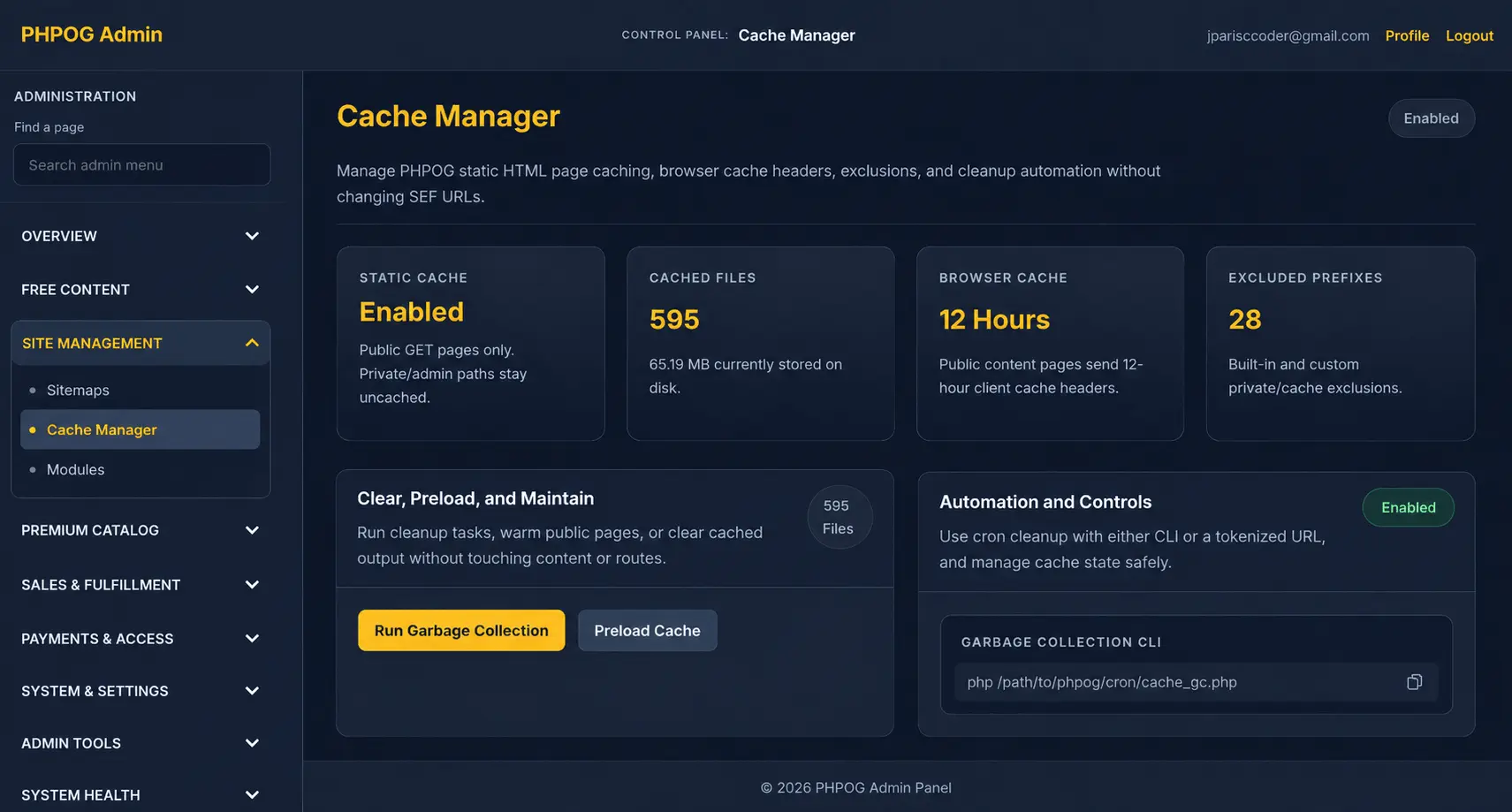
It includes public code libraries, educational content, blog publishing, administrative tools, customer-facing systems, search-engine-friendly routes, sitemap management, caching, sharing features, and an interactive PHP academy.
Those areas have different requirements, and a custom CMS allows each one to be built around its actual purpose.
The public code libraries can focus on readable examples and structured explanations. The blog can publish clean, permanent articles without carrying the overhead of an unrelated page-building system. The academy can provide its own learning interface without being forced into the assumptions of a third-party course platform.
The administration area can expose the tools required to manage the site without displaying hundreds of options that do not apply.
The result is not merely a smaller system. It is a more intentional one.
Performance Begins With Restraint
Website performance is often treated as something that gets repaired after a site becomes slow.
More caching is added, images are compressed, scripts are delayed, and a performance plugin is installed to clean up the problems created by other plugins.
That is backward.
Performance should begin with what the site chooses not to load.
PhpOG.com does not need a large JavaScript framework to open a menu, switch a tab, copy code, or display a message because plain JavaScript can handle those tasks directly.
It does not need an enormous CSS library to create a grid, a button, or a responsive layout. The stylesheet can contain only the rules the site actually uses.
It does not need a plugin system to perform every database query. The application can request the exact data required for the page.
Every avoided dependency removes work. The browser has less code to download, the server has less code to interpret, and the database receives more focused requests.
There are fewer files to load, fewer systems to initialize, and fewer places for unexpected behavior to hide.
Speed is not created by one clever trick. It is created by hundreds of disciplined decisions.
The Server Does Less Guessing
General-purpose content management systems must support many different kinds of websites.
They need hooks, filters, extensions, template engines, compatibility layers, and fallback behavior. That flexibility is useful, but it carries a cost.
A custom system already knows what it is.
When someone requests a code library page, the application does not need to ask dozens of plugins whether they want to modify the request. When someone opens a blog post, the system does not need to assemble the page through a chain of unrelated modules.
The route, controller, template, and required data are already known, so the response can be built directly.
That clarity improves performance, but it also improves reliability. A system with fewer moving parts has fewer opportunities for one update to break something on the other side of the site.
Control Over Every Layer
One of the greatest advantages of custom code is ownership of the entire process.
The site controls its routes, database structure, HTML output, metadata, caching, administrative workflow, browser-side behavior, and server-side operations.
That level of control is especially important for search engine optimization.
Clean URLs do not have to be forced through a plugin. Canonical addresses do not depend on a theme making the correct decision. Page titles, descriptions, Open Graph data, structured navigation, and sitemap entries can be generated from the same source of truth used by the application itself.
The CMS does not need to negotiate with several systems to decide what a page is called.
It already knows.
Security Through Simplicity
No system is automatically secure merely because it is custom.
Poor custom code can be dangerous.
Good custom code, however, has one major security advantage: it can have a much smaller attack surface.
A website cannot be attacked through a plugin that was never installed, inherit a vulnerability from a framework component it does not use, or expose an abandoned theme feature that was left enabled by default.
A custom CMS still requires disciplined validation, prepared database operations, session protection, permission checks, secure file handling, and careful output escaping.
The advantage is that those protections can be designed around the real application instead of being spread across unrelated packages written by different vendors with different assumptions.
The security model can remain centralized, understandable, and reviewable.
That does not eliminate responsibility. It makes responsibility clearer.
Updates Do Not Control the Site
Many website owners do not truly control their own systems.
A plugin update can change the interface, a theme update can break a layout, and a framework upgrade can deprecate working code. A vendor can also change its pricing, license, API, or support policy.
The owner may possess the files while still being dependent on decisions made elsewhere.
Custom code changes that relationship.
PhpOG.com can be updated when the site needs an update. A feature can be improved without waiting for a plugin author, and a problem can be fixed without searching through layers of abstraction.
A new module can follow the existing architecture instead of being forced into someone else’s product model.
The system grows according to the needs of the project.
That is real ownership.
Built for the People Using It
Custom development also makes it possible to build for a specific audience.
PhpOG.com is designed to serve people who want to understand code, not merely copy it.
That goal affects the entire CMS.
Code examples need room to breathe, explanations need to remain readable, and navigation needs to separate free libraries, premium resources, educational material, and site information without becoming confusing.
Administrative tools need clear descriptions rather than unexplained technical labels.
The site is not trying to become every kind of website. It is trying to perform its own mission well.
That focus is one of the strongest forms of optimization.
The Power Is Not Only Speed
Performance is one of the clearest advantages of custom code, but it is not the only one.
The deeper advantage is alignment.
The database matches the content, the interface matches the audience, the routes match the site structure, the administrative tools match the work, and the source code matches the values behind the project.
That alignment is difficult to achieve when a website is assembled from parts built for completely different purposes.
Custom code allows the system to speak with one voice.
The Cost of Custom Development
Custom software is not free.
It requires planning, testing, maintenance, and a developer who understands the system beyond the surface level.
When something breaks, there may not be a plugin support forum waiting with an answer.
The responsibility remains with the people who built it.
That is the cost, but it is also the value.
A developer who understands the full system can diagnose problems that would be difficult to trace through a large stack of outside dependencies.
The knowledge stays close to the application, the architecture remains intentional, and the code can be repaired rather than replaced.
Built to Last
Technology changes quickly.
Good software does not survive by chasing every trend. It survives by keeping its foundations clear.
PHP remains widely used because it solves the problem of serving dynamic web content directly and efficiently. MySQL remains dependable because structured data still needs to be stored, searched, and managed. HTML, CSS, and JavaScript remain the language of the browser.
PhpOG.com builds on those foundations.
The system does not avoid modern practices. It avoids unnecessary complexity.
There is a difference.
Modern development should improve security, accessibility, performance, and maintainability. It should not require a website to carry a warehouse of dependencies merely to display useful information.
Code Should Serve the Work
The custom CMS behind PhpOG.com reflects a simple belief.
Code should serve the work. The work should not become a servant to the code.
Every feature should justify its presence, every dependency should justify its cost, every request should do only what it needs to do, and every page should be understandable to the person using it.
That discipline produces speed, control, and stability while creating a system that can grow without losing sight of why it was built.
Custom code is not always the correct answer for every project.
For PhpOG.com, it is the foundation that makes the project possible.
The power does not come from using the most code. It comes from knowing exactly which code the site needs.